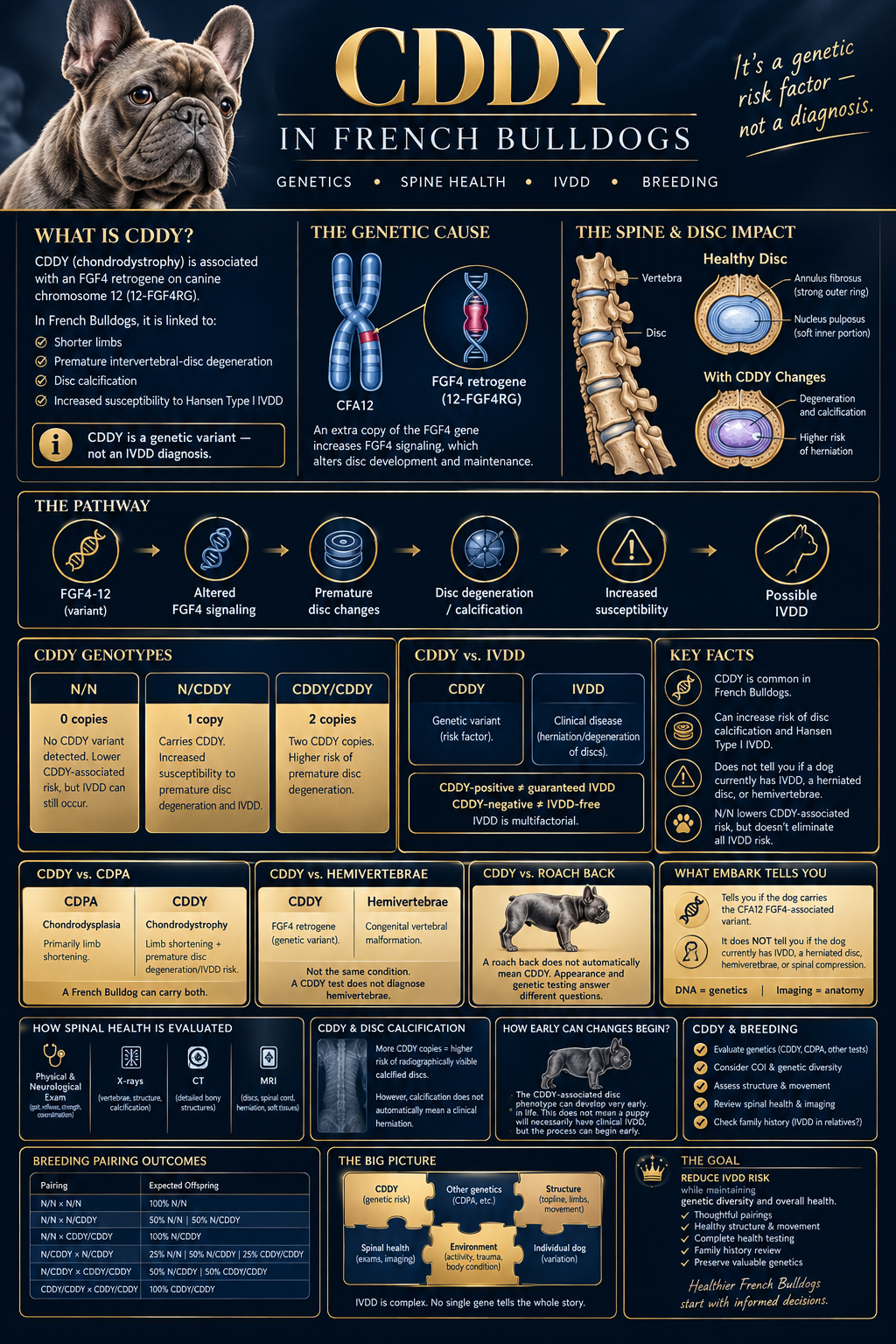
CDDY IN FRENCH BULLDOGS
Genetics • Spine Health • IVDD • Breeding
WHAT IS CDDY?
CDDY = Chondrodystrophy.
CDDY is associated with an FGF4 retrogene on canine chromosome 12, commonly called 12-FGF4RG or FGF4-12.
In French Bulldogs, this genetic variant is important because it is associated with:
Shorter limbs
Premature intervertebral-disc degeneration
Disc calcification
Increased susceptibility to Hansen Type I IVDD
The important point
CDDY is a genetic risk factor — not an IVDD diagnosis.
WHY DOES CDDY MATTER?
French Bulldogs are naturally a chondrodystrophic breed, and CDDY is extremely common within the breed.
The CDDY-associated FGF4 variant affects the biology of the intervertebral discs.
A simplified pathway is:
FGF4-12
↓
Altered FGF4 signaling
↓
Premature disc degeneration
↓
Disc calcification
↓
Greater susceptibility to disc herniation
↓
Possible IVDD
CDDY & THE INTERVERTEBRAL DISC
Each spinal disc contains two primary components:
Annulus Fibrosus
The strong outer ring.
Nucleus Pulposus
The softer inner portion.
In CDDY-associated chondrodystrophy, the disc can undergo premature degeneration and calcification.
As the disc degenerates, it can become more susceptible to herniation.
CDDY DOES NOT EQUAL IVDD
This distinction is extremely important.
CDDY
A genetic variant associated with increased risk.
IVDD
A clinical disease involving degeneration and/or herniation of intervertebral discs.
Therefore:
CDDY-positive ≠ guaranteed IVDD
And:
CDDY-negative ≠ guaranteed IVDD-free
IVDD is a complex, multifactorial condition.
CDDY GENOTYPES
N/N
0 copies
No CDDY-associated variant detected.
Generally means the dog does not carry the CFA12 CDDY variant.
However, the dog can still develop IVDD from other genetic, structural, or environmental factors.
N/CDDY
1 copy
The dog carries one CDDY copy.
One copy is already associated with increased susceptibility to premature disc degeneration and IVDD.
This dog can pass CDDY to approximately 50% of its offspring when bred to an N/N dog.
CDDY/CDDY
2 copies
The dog carries two CDDY copies.
Two copies are associated with the CDDY phenotype and increased susceptibility to premature disc degeneration.
When bred to an N/N dog:
100% of puppies are expected to inherit one CDDY copy.
CDDY & IVDD RISK
Think of CDDY as a risk factor, not a prediction.
CDDY can increase:
Premature disc degeneration
Disc calcification
Susceptibility to disc herniation
Risk of Hansen Type I IVDD
Potential for earlier clinical disease
But CDDY does NOT tell you:
Whether a dog currently has IVDD
Whether a disc is currently herniated
How many discs are calcified
When IVDD will occur
Whether surgery will ever be necessary
CAN N/N DOGS GET IVDD?
YES.
This is one of the most important facts for breeders.
An N/N result lowers CDDY-associated risk, but it does not eliminate all possible causes of IVDD.
Other factors may include:
Other genes
Spinal anatomy
Disc structure
Vertebral abnormalities
Body condition
Trauma
High-impact activity
Age
Environmental factors
Bottom line:
N/N = lower CDDY-associated risk
NOT = zero IVDD risk
CDDY VS CDPA
These two genetic variants are often confused.
CDPA
Chondrodysplasia
Primarily associated with limb shortening.
CDDY
Chondrodystrophy
Associated with limb shortening and premature intervertebral-disc degeneration/IVDD susceptibility.
A French Bulldog can potentially carry both variants.
CDDY VS HEMIVERTEBRAE
They are not the same condition.
CDDY
A genetic variant involving the FGF4 retrogene on CFA12.
Hemivertebrae
A congenital vertebral malformation caused by abnormal development of a vertebra.
A French Bulldog can have:
CDDY without significant hemivertebrae
Hemivertebrae without CDDY
or
Both.
A CDDY DNA test does not diagnose hemivertebrae.
CDDY VS ROACH BACK
A roach-backed French Bulldog should not automatically be assumed to have CDDY-related spinal disease.
Topline appearance can be influenced by:
Vertebral structure
Body proportions
Musculature
Conformation
Genetics
Individual anatomy
Likewise:
A beautiful topline does not prove that the discs are healthy.
Appearance and genetic testing answer different questions.
WHAT DOES AN EMBARK CDDY RESULT TELL YOU?
A CDDY DNA result tells you whether the dog carries the CFA12 FGF4-associated variant.
It does not tell you whether the dog currently has:
A herniated disc
Disc compression
Neurological disease
Hemivertebrae
Disc calcification
Spinal cord compression
DNA testing = genetic information
Imaging = physical/anatomical information
They complement each other.
HOW IS SPINAL HEALTH EVALUATED?
Depending on the clinical question, veterinarians may use:
Physical & Neurological Examination
Evaluates:
Gait
Strength
Reflexes
Pain
Coordination
Neurological function
Radiographs
Can help evaluate:
Vertebral anatomy
Some spinal abnormalities
Visible disc calcification
CT
Provides detailed information about bony spinal structures.
MRI
Provides detailed information about:
Intervertebral discs
Spinal cord
Disc herniation
Compression
Soft tissues
CDDY & DISC CALCIFICATION
Disc calcification is an important part of the CDDY story.
Research has found an association between additional CDDY copies and increased numbers of radiographically visible calcified discs.
This helps explain why CDDY is associated with premature disc degeneration.
However:
Disc calcification does not automatically mean the dog will suffer a clinical disc herniation.
HOW EARLY CAN CHANGES BEGIN?
The CDDY-associated disc phenotype can develop very early in life.
Research has reported evidence of the phenotype in young dogs.
This does not mean a puppy will necessarily develop clinical IVDD.
It means that the underlying biological process can begin long before obvious neurological symptoms appear.
CDDY & BREEDING
For breeders, CDDY should be considered as one part of a larger breeding-health strategy.
Evaluate:
GENETICS
CDDY
CDPA
Other relevant health tests
COI
Genetic diversity
STRUCTURE
Topline
Movement
Limb structure
Vertebral anatomy
Overall balance
SPINAL HEALTH
Veterinary examination
Relevant imaging
Disc history
Neurological history
FAMILY HISTORY
Look at:
Parents
Grandparents
Siblings
Half-siblings
Previous offspring
Older relatives
Ask:
Has IVDD occurred repeatedly within this family?
CDDY & COI
These are completely different measurements.
CDDY
A specific genetic variant.
COI
A measure of genetic relatedness/inbreeding.
A dog can be:
Low COI + CDDY positive
or
High COI + CDDY negative
They answer different questions.
BREEDING PAIRINGS
N/N × N/N
Expected:
100% N/N
N/N × N/CDDY
Expected:
50% N/N
50% N/CDDY
N/N × CDDY/CDDY
Expected:
100% N/CDDY
N/CDDY × N/CDDY
Expected:
25% N/N
50% N/CDDY
25% CDDY/CDDY
N/CDDY × CDDY/CDDY
Expected:
50% N/CDDY
50% CDDY/CDDY
CDDY/CDDY × CDDY/CDDY
Expected:
100% CDDY/CDDY
SHOULD CDDY-POSITIVE DOGS BE REMOVED?
There is no simple "positive = never breed" rule that captures the entire problem.
CDDY is extremely common in French Bulldogs.
Removing large numbers of dogs from breeding solely because they carry CDDY could potentially reduce genetic diversity and increase other genetic risks.
A better approach is:
REDUCE RISK
while also
PRESERVING GENETIC DIVERSITY
and selecting for:
Healthy structure
Good movement
Appropriate body condition
Strong overall health
Favorable family history
Responsible genetic pairings
WHAT CDDY CANNOT TELL YOU
A CDDY test cannot predict:
❌ Exact age of IVDD onset
❌ Whether IVDD will occur
❌ Whether surgery will be needed
❌ Number of affected discs
❌ Presence of hemivertebrae
❌ Current disc herniation
❌ Current spinal-cord compression
❌ Overall spinal health
It provides important genetic-risk information, but it is not a complete spinal-health examination.
THE BIG PICTURE
Think of French Bulldog spinal health as several pieces of a puzzle:
1. CDDY
Genetic predisposition to premature disc degeneration.
2. VERTEBRAL ANATOMY
Hemivertebrae and other structural abnormalities.
3. DISC HEALTH
Degeneration and calcification.
4. OTHER GENETICS
Additional genes may influence IVDD susceptibility.
5. ENVIRONMENT
Activity, trauma, body condition and other factors.
6. INDIVIDUAL DOG
Every dog can respond differently.
CDDY IN ONE SIMPLE DIAGRAM
CDDY
↓
FGF4-12 RETROGENE
↓
ALTERED FGF4 SIGNALING
↓
PREMATURE DISC CHANGES
↓
DISC DEGENERATION / CALCIFICATION
↓
INCREASED SUSCEPTIBILITY
↓
POSSIBLE DISC HERNIATION
↓
POSSIBLE IVDD
BUT:
RISK ≠ CERTAINTY
RESPONSIBLE BREEDING PRINCIPLE
The goal should not simply be:
"Eliminate one gene."
The broader goal should be:
REDUCE IVDD RISK WHILE MAINTAINING GENETIC DIVERSITY AND OVERALL HEALTH.
That means considering the entire dog, pedigree, genetic profile, structure, spinal history and breeding combination.
QUICK CDDY REFERENCE
ResultCopiesMeaningN/N0No CDDY variant detectedN/CDDY1Carries CDDY; increased IVDD susceptibilityCDDY/CDDY2Two copies; increased CDDY-associated disc riskCDDY = IVDD?—NoN/N = IVDD-free?—NoCDDY = hemivertebrae?—NoCDDY = CDPA?—NoDNA test = spinal diagnosis?—No
FINAL TAKEAWAY
CDDY is one of the most important genetic factors to understand when discussing IVDD in French Bulldogs.
It is strongly associated with premature intervertebral-disc degeneration and increased susceptibility to Hansen Type I IVDD, but it does not determine an individual dog's fate.
The most responsible evaluation combines:
CDDY testing
other genetic testing
COI/genetic diversity
family IVDD history
vertebral/spinal evaluation
overall structure and health
The goal is not simply to produce a CDDY-negative dog.
The goal is to produce a healthier French Bulldog with the best possible balance of genetics, structure, spinal health, temperament and genetic diversity.