INBREEDING • LINEBREEDING • OUTCROSSING
A PROFESSIONAL PERSPECTIVE ON BREEDING STRATEGY, GENETICS & THE FUTURE OF A BLOODLINE
Exceptional breeding begins with knowledge, intention, and a long-term vision.
A successful breeding program is not built around a single pairing, a single generation, or appearance alone. It is built through careful evaluation of pedigrees, genetics, health, structure, temperament, and the qualities that define a family of dogs.
Among the most important concepts breeders should understand are inbreeding, linebreeding, and outcrossing.
Each represents a different approach to managing genetic relationships within a breeding program. Used thoughtfully, these strategies can help a breeder preserve desirable qualities, address weaknesses, maintain genetic diversity, and move a bloodline toward a clearly defined goal.
The key is understanding why a breeding is being made—not simply how closely related the parents are.
THE FOUNDATION OF A BREEDING PROGRAM
BREEDING SHOULD ALWAYS HAVE A PURPOSE
A pedigree is not simply a collection of names.
It represents generations of genetics, traits, strengths, weaknesses, successes, and potential risks.
When evaluating a prospective pairing, a breeder should look beyond the individual dogs and consider the families behind them.
What qualities does each dog consistently produce?
What weaknesses exist within each family?
Which ancestors appear repeatedly?
What health concerns are present in the pedigree?
What traits should be preserved?
What traits should be improved?
How closely related are the prospective parents?
What genetic testing is available?
What is the long-term objective of the breeding program?
The answers to these questions help determine whether an inbreeding, linebreeding, or outcross may be appropriate.
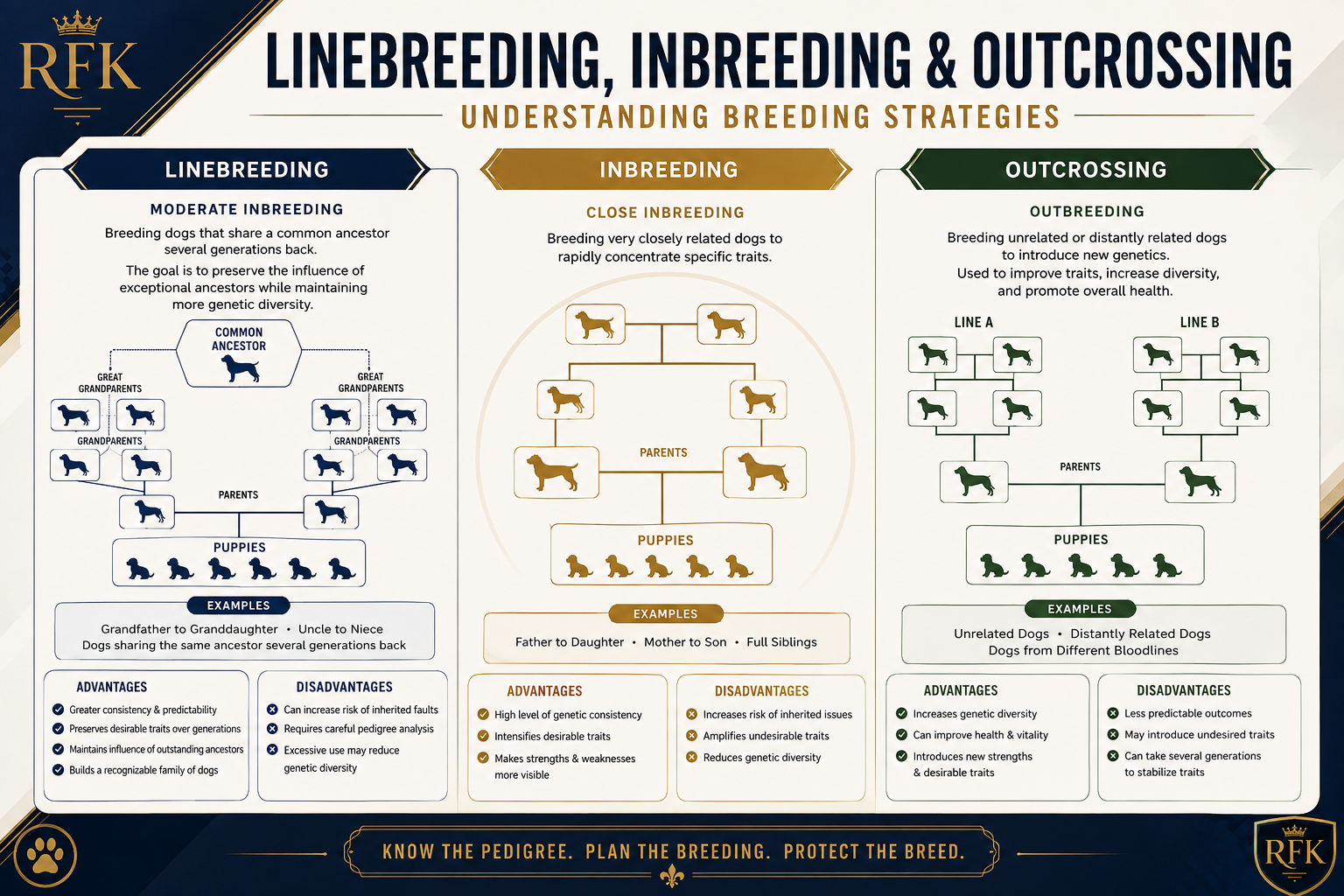
INBREEDING
CONCENTRATING GENETICS THROUGH CLOSE RELATIONSHIPS
Inbreeding refers to breeding closely related dogs.
Examples include:
Parent to offspring
Full sibling to full sibling
Other very close familial pairings
The underlying principle is genetic concentration. Closely related dogs share a greater proportion of their genetic material, increasing the likelihood that offspring will inherit similar genetic combinations from both parents.
Historically, close inbreeding has been used to establish or reinforce specific characteristics within families and bloodlines.
A breeder may seek to preserve traits such as:
TYPE • STRUCTURE • BONE • HEAD • SIZE • COAT • MOVEMENT • TEMPERAMENT
However, genetics do not distinguish between traits a breeder considers desirable and those they do not.
The same concentration that can reinforce desirable characteristics can also increase the likelihood of pairing harmful recessive genetic variants.
THE RESPONSIBILITY OF CLOSE BREEDING
For this reason, close inbreeding requires an exceptionally high level of knowledge and preparation.
Potential concerns associated with increased genetic concentration can include:
Increased expression of recessive genetic disorders
Reduced genetic diversity
Reduced fertility
Smaller litter sizes
Reduced vigor
Increased susceptibility to certain inherited conditions
Close breeding should therefore never be undertaken simply to produce a particular look or because a pedigree is considered prestigious.
The closer the relationship, the greater the responsibility to understand what is being concentrated.
LINEBREEDING
PRESERVING FAMILY INFLUENCE WITH GREATER GENETIC DISTANCE
Linebreeding is generally used to describe breeding related dogs that share important ancestors, but are not as closely related as the most concentrated forms of inbreeding.
The objective is often to retain the influence of a particular ancestor, family, or established line while maintaining greater genetic distance than a close inbreeding.
For a breeder, linebreeding can be a way of building continuity.
It may help preserve characteristics that have been intentionally developed over multiple generations, including:
CONSISTENT TYPE
STRUCTURAL QUALITY
BONE & SUBSTANCE
HEAD CHARACTERISTICS
TEMPERAMENT
WORKING ABILITY
COAT QUALITY
OTHER FAMILY TRAITS
THE STRENGTH OF A FAMILY
When a particular family has demonstrated consistent qualities over generations, a breeder may want to maintain that influence rather than continually introducing unrelated genetics.
This is where thoughtful linebreeding can become an important part of a long-term program.
But linebreeding should never be confused with eliminating genetic risk.
If undesirable genetic variants exist within the family being concentrated, linebreeding can increase the possibility that those variants will eventually meet.
Linebreeding preserves genetics—not just the traits we admire.
That distinction is critical.
OUTCROSSING
INTRODUCING GENETIC DIVERSITY & NEW POSSIBILITIES
Outcrossing involves breeding dogs that are more distantly related, often from different families or bloodlines within the same breed.
An outcross can be used when a breeder believes a new genetic contribution may strengthen the direction of the program.
Reasons for considering an outcross may include:
Increasing genetic diversity
Reducing excessive concentration of particular ancestors
Introducing desirable traits
Addressing weaknesses within an established line
Expanding future breeding options
Bringing together complementary families
An outcross can create new genetic combinations that may not be available within a more closely related family.
However, outcrossing should not be viewed as a shortcut.
DIFFERENT DOES NOT AUTOMATICALLY MEAN BETTER
An unrelated dog can introduce desirable qualities—but it can also introduce undesirable ones.
A breeder must therefore evaluate the complete genetic and phenotypic picture of both families.
The objective should not simply be to find a dog that is unrelated.
The objective should be to find a dog whose strengths complement the existing program.
BREEDING TO COMPLEMENT
THE ART OF BALANCING STRENGTHS & WEAKNESSES
One of the most important concepts in serious breeding is the principle of complementary breeding.
No dog is perfect.
Every dog has strengths. Every dog has weaknesses.
The breeder's responsibility is to identify those qualities honestly and select a mate that complements them.
A dog may possess exceptional structure and bone while requiring improvement in another area.
Rather than simply choosing another dog with similar qualities, the breeder may look for a mate that:
PRESERVES THE STRENGTHS
IMPROVES THE WEAKNESSES
MAINTAINS OVERALL QUALITY
This requires discipline.
Breeding should not be driven solely by emotion, popularity, titles, color, or a famous name in a pedigree.
The question should always be:
“WHAT DOES THIS PAIRING HAVE THE POTENTIAL TO IMPROVE?”
THE COEFFICIENT OF INBREEDING
UNDERSTANDING GENETIC RELATIONSHIP
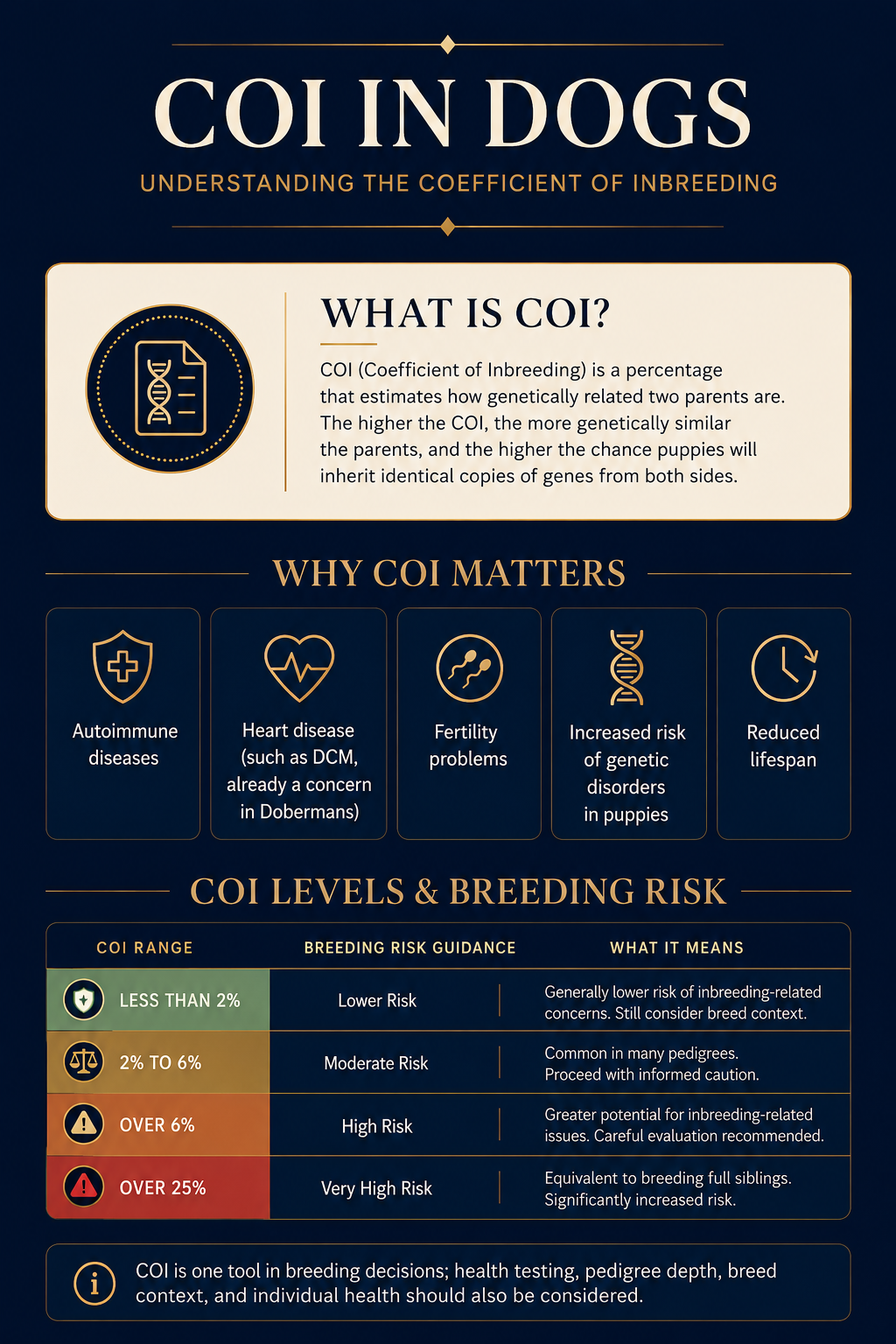
The Coefficient of Inbreeding (COI) is an important tool for breeders evaluating genetic relationships.
In simplified terms, COI estimates the probability that an offspring will inherit two copies of a gene that are identical by descent because of shared ancestry.
It can help breeders identify the degree of genetic concentration expected from a particular pairing.
However, COI should be interpreted carefully.
A COI is not a health guarantee.
A lower COI does not guarantee healthy puppies, and a higher COI does not mean that every puppy will develop a genetic disorder.
COI is best viewed as one component of a much larger evaluation.
THE PEDIGREE MATTERS
A pedigree that appears relatively open over three generations may reveal significant repeated ancestry when examined further back.
For this reason, serious pedigree analysis should consider multiple generations whenever reliable information is available.
The more complete the information, the more informed the breeding decision can become.
HEALTH MUST COME FIRST
GENETICS • TESTING • RESPONSIBLE SELECTION
Pedigree analysis and breeding strategy should never replace health evaluation.
A responsible breeding program should investigate the health concerns relevant to the breed and use appropriate testing whenever reliable tests are available.
Depending on the breed, this may include:
DNA TESTING
Identification of known inherited genetic conditions and carrier status where validated tests exist.
ORTHOPEDIC EVALUATION
Assessment of hips, elbows, patellas, or other breed-relevant orthopedic concerns.
CARDIAC EVALUATION
Screening for recognized hereditary or structural cardiac concerns.
OPHTHALMIC EVALUATION
Examination for inherited or breed-associated eye conditions.
BREED-SPECIFIC TESTING
Additional examinations or genetic screening recommended for the particular breed.
Health testing is not simply a certificate to place in a folder.
It is information that should influence breeding decisions.
THE PEDIGREE IS MORE THAN A LIST OF NAMES
LOOKING BEYOND THE INDIVIDUAL
A dog should never be evaluated solely by what is visible today.
A responsible breeder studies the family behind the dog.
This can include examining:
PARENTS
GRANDPARENTS
SIBLINGS
PREVIOUS OFFSPRING
REPEATED ANCESTORS
HEALTH HISTORIES
LONGEVITY
TEMPERAMENT
STRUCTURAL CONSISTENCY
REPRODUCTIVE HISTORY
GENETIC TESTING
KNOWN FAMILY STRENGTHS
KNOWN FAMILY WEAKNESSES
Patterns become more meaningful when viewed across generations.
The objective is to understand not only what a dog is, but what its family has historically contributed.
BREEDING FOR THE NEXT GENERATION
THINKING BEYOND A SINGLE LITTER
The strongest breeding programs are not built one litter at a time.
They are built one generation at a time.
A successful pairing should be evaluated not only by the puppies it produces, but by what those puppies may contribute to the future of the program.
This means considering:
WHAT QUALITIES ARE WE PRESERVING?
WHAT WEAKNESSES ARE WE IMPROVING?
WHAT GENETICS ARE WE INTRODUCING?
WHAT GENETICS ARE WE CONCENTRATING?
WHAT WILL THIS BREEDING ALLOW US TO DO IN THE NEXT GENERATION?
This long-term approach creates a breeding program with direction rather than a series of unrelated pairings.
THERE IS NO UNIVERSAL FORMULA
Inbreeding, linebreeding, and outcrossing are breeding strategies—not guarantees.
There is no single formula that produces exceptional offspring every time.
One program may benefit from maintaining a carefully established family.
Another may require an outcross to introduce new genetics.
Another may use selective linebreeding to preserve a particular family while gradually improving weaknesses.
The appropriate decision depends on:
THE INDIVIDUAL DOGS
THEIR PEDIGREES
THEIR GENETICS
THEIR HEALTH
THEIR STRUCTURE
THEIR TEMPERAMENT
THEIR FAMILY HISTORY
THE LONG-TERM OBJECTIVE OF THE PROGRAM
THE STRATEGY SHOULD SERVE THE GOAL—not the other way around.
PRESERVING WHAT MATTERS
IMPROVING WHAT DOESN'T
A breeding program should never be afraid to acknowledge weaknesses.
Preserving a family does not mean preserving every characteristic within it.
Improving a bloodline requires the ability to recognize what should remain—and what should change.
Sometimes that means linebreeding.
Sometimes that means outcrossing.
And sometimes the most responsible decision is to step away from a particular pairing altogether.
The objective is always progress.
THE BOTTOM LINE
Inbreeding concentrates genetics through close relationships.
Linebreeding seeks to maintain the influence of important ancestors and families while generally using less closely related dogs.
Outcrossing introduces greater genetic distance and can expand genetic diversity within a breeding program.
None of these strategies should be viewed in isolation.
The strongest decisions come from combining:
PEDIGREE KNOWLEDGE
HEALTH INFORMATION
GENETIC TESTING
STRUCTURAL EVALUATION
TEMPERAMENT
FAMILY HISTORY
A CLEAR BREEDING OBJECTIVE
The future of a bloodline is shaped by the decisions made today.
BREED WITH PURPOSE
PRESERVE WHAT IS EXCEPTIONAL.
IMPROVE WHAT NEEDS IMPROVEMENT.
PROTECT THE FUTURE OF THE BLOODLINE.