BREEDING METHODS & PEDIGREE FORMULAS
A Strategic Approach to Building Generations
Breeding is a long-term process of selection, preservation, evaluation, and genetic planning.
Understanding how different breeding methods work allows a breeder to make more informed decisions about how traits, families, and bloodlines are carried forward from one generation to the next.
THE FOUNDATION
BREEDING IS A STRATEGY
A successful breeding program begins with understanding the pedigree.
Before selecting a pairing, consider:
WHAT ARE WE PRESERVING?
WHAT ARE WE IMPROVING?
WHAT ARE WE INTRODUCING?
WHAT ARE WE TRYING TO AVOID?
Every breeding method provides a different way of answering those questions.
EXPLORE THE METHODS
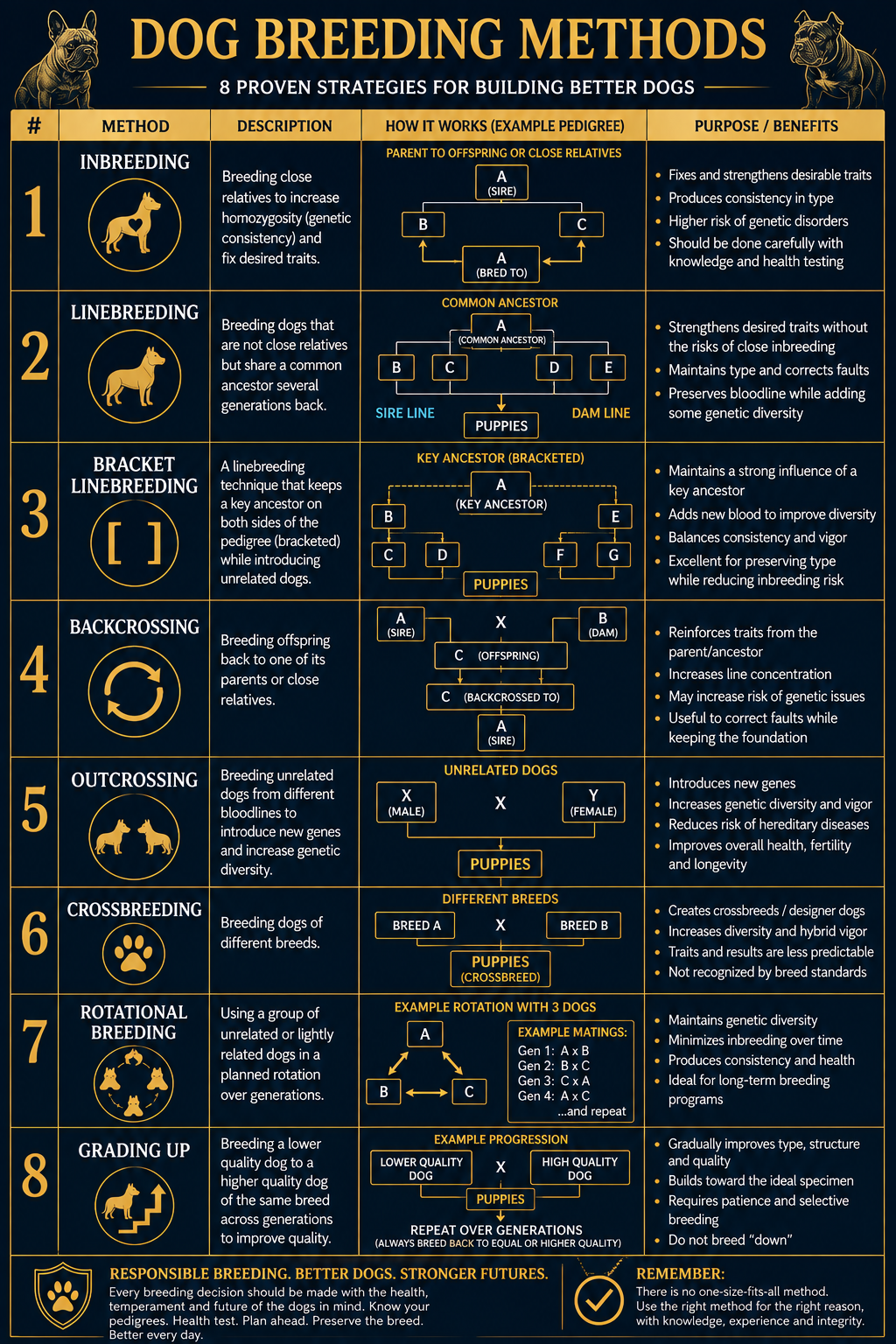
1=INBREEDING
CLOSE GENETIC CONCENTRATION
Parent × Offspring
Full Sibling × Full Sibling
PRIMARY OBJECTIVE
Increase genetic concentration and homozygosity within a pedigree.
KEY CONCEPT
Concentrate.
2=LINEBREEDING
CONTROLLED FAMILY CONCENTRATION
Related × Related
with a valued ancestor or family appearing within the pedigree.
PRIMARY OBJECTIVE
Maintain the influence of a proven family while using a greater degree of genetic separation than close inbreeding.
KEY CONCEPT
Preserve.
3=BRACKET LINEBREEDING
FAMILY REPRESENTATION FROM BOTH SIDES
             TARGET ANCESTOR
              /           \
             /             \
        FAMILY A         FAMILY B
           │                 │
           │                 │
           └───────┬─────────┘
                   │
             SELECTED PAIRING
                   │
                   ▼
              NEXT GENERATION
PRIMARY OBJECTIVE
Keep a desired ancestor or family represented through both sides of the pedigree while strategically managing additional genetics.
KEY CONCEPT
Bracket.
4=BACKCROSSING
RETURNING TOWARD A PARENTAL LINE
          PARENT A
          /      \
     OFFSPRING   OFFSPRING
          │
          ×
       PARENT A
          │
          ▼
      BACKCROSS
PRIMARY OBJECTIVE
Increase the influence of a particular parent or established line.
KEY CONCEPT
Reinforce.
5=OUTCROSSING
INTRODUCING NEW GENETICS
       LINE A          LINE B
          │              │
          └────── × ─────┘
                 │
                 ▼
          NEW COMBINATION
                 │
                 ▼
          SELECTED OFFSPRING
PRIMARY OBJECTIVE
Introduce relatively unrelated genetics into the breeding program.
KEY CONCEPT
Introduce.
6=CROSSBREEDING
COMBINING DISTINCT POPULATIONS
        BREED / LINE A
               │
               ×
        BREED / LINE B
               │
               ▼
        CROSSBRED OFFSPRING
PRIMARY OBJECTIVE
Combine characteristics from different breeds or genetic populations.
KEY CONCEPT
Combine.
7=ROTATIONAL BREEDING
MULTI-LINE GENERATIONAL STRATEGY
       LINE A × LINE B
              │
              ▼
        NEXT GENERATION
              │
              ×
            LINE C
              │
              ▼
        NEXT GENERATION
              │
              ×
            LINE A
              │
              ▼
            REPEAT
PRIMARY OBJECTIVE
Use multiple lines in a structured sequence across generations.
KEY CONCEPT
Rotate.
8=GRADING UP
PROGRESSIVELY INCREASING LINE INFLUENCE
     FOUNDATION × SELECTED LINE
                │
                ▼
             OFFSPRING
                │
                ×
        SELECTED LINE
                │
                ▼
             OFFSPRING
                │
                ×
        SELECTED LINE
                │
                ▼
       INCREASED INFLUENCE
PRIMARY OBJECTIVE
Progressively increase the genetic influence of a selected breed or line.
KEY CONCEPT
Build.
THE BREEDING DECISION
WHICH METHOD FITS THE OBJECTIVE?
A breeding method should be selected based on the purpose of the pairing — not simply because a particular formula looks attractive on paper.
                 BREEDING GOAL
                       │
          ┌────────────┼────────────┐
          ▼            ▼            ▼
       PRESERVE     IMPROVE      INTRODUCE
          │            │            │
          ▼            ▼            ▼
     LINEBREEDING   BACKCROSS    OUTCROSS
          │
          ▼
       BRACKET
          │
          ▼
       SELECT
          │
          ▼
      EVALUATE
          │
          ▼
     NEXT GENERATION
PEDIGREE • PURPOSE • SELECTION
THE THREE-PART APPROACH
PEDIGREE
Understand where the genetics come from.
↓
PURPOSE
Determine what the pairing is intended to accomplish.
↓
SELECTION
Evaluate the offspring and determine which individuals should continue the program.
BUILDING GENERATIONS
THE FORMULA IS ONLY THE BEGINNING
A pedigree formula can help describe a breeding strategy, but the real value comes from the decisions made before and after the pairing.
STUDY THE PEDIGREE
↓
DEFINE THE OBJECTIVE
↓
SELECT THE METHOD
↓
MAKE THE PAIRING
↓
EVALUATE THE OFFSPRING
↓
SELECT THE NEXT GENERATION
↓
REPEAT WITH PURPOSE
FINAL STATEMENT
BREED WITH PURPOSE.
A thoughtfully designed breeding program looks beyond one pairing.
It considers the pedigree, the genetic relationships, the desired characteristics, the potential risks, and the generations that follow.
Preserve what matters.
Improve what needs improvement.
Introduce what is needed.
Select with purpose.
BUILD THE NEXT GENERATION WITH INTENTION..